


For centuries we accepted an implicit premise of the world order: that unlimited growth, social costs, and ecological degradation were an inevitable price of progress. In doing so, we consolidated an extractive world-system. But today the question is no longer just how to correct its excesses. The question is whether we can design a new economic and institutional architecture based on different premises, different rules, and different incentives.
In this note we explore an increasingly urgent hypothesis: that the next regenerative economic systems and decentralized governance are already emerging in parallel with the institutions of the old world order, in experimental territories, special jurisdictions and global networks of innovators.
In May 2026, in Próspera, 55 selected people will put that hypothesis to the test.
📍 Key data
Pop-Up Island: Founding Sprint del Regen District
📅 May 18–31, 2026
📍 Próspera ZEDE — Roatán, Honduras
👥 55 selected builders
⏳ 15 days
📝 Application required
→ Luma Event
→ Apply Here
→ Apply Scholarships
TL;DR
For 15 days we’re going to work on something radical: co-designing and laying the foundations of the first Regenerative Impact Special Economic Zone (RISEZ), starting from a Regen District within Próspera where capital, technology, and governance align to make regeneration measurable, investable, and scalable.
What does it mean for it to be a district within Próspera?
Próspera already operates as a ZEDE (Special Economic Development Zone): a special jurisdiction with its own legal framework that allows for experimentation with new economic, regulatory, and governance rules. Within this framework, different projects can create districts or communities with their own operating rules, always under the legal umbrella of the jurisdiction.
The Special Regenerative District will function precisely like this: an institutional ecosystem within Próspera, where those of us who participate in its foundation can design a specific layer of regenerative market, decentralized governance, and verifiable metrics.
This implies that:
We will operate under the legal certainty and institutional framework of Próspera,
We will have the freedom to define governance rules oriented toward regeneration,
We will establish ecological and social impact metrics,
We will create economic incentives to promote regenerative markets,
and we will coordinate a community of capital, projects, companies, and builders aligned with these principles.
In other words, we are not creating a new jurisdiction from scratch; we are building a new specialized institutional layer within an existing jurisdiction, specifically designed to enable this kind of innovation.
In two weeks we will design:
• Governance system and Constitution of the Special Regenerative District
• Legal and financial infrastructure
• Verifiable impact metrics framework
• Regenerative capital architecture and regenerative fund blueprint
• Cosmo-local roadmap towards 2040
It’s not a conference.
It’s not a retreat with pretty pictures on a paradise island.
It’s an institutional founding sprint.
Polycrisis as a symptom that the current operating system has become obsolete
We are experiencing a polycrisis: increasing geopolitical fragmentation and instability, structural inequality, climate change, ecological collapse, technological acceleration without adequate governance, and a crisis of institutional legitimacy. Global Risks Report 2026 It points out that the global system is entering a phase of systemic competition where traditional institutions are finding it increasingly difficult to coordinate complex solutions.
The current global institutions we inherited were designed more than 300 years ago for a world very different from the one we actually live in: centralized nation-states, extractive markets, industrial economies, financial capital decoupled from the real economy and territory, slow bureaucracies, rigid boundaries between the legal, the physical and the digital.
But the playing field has changed, because something is emerging in parallel and already exists tools:
Experimental jurisdictions
Regenerative economies
Blockchain-based financial and distributed governance infrastructures (smart contracts, asset tokenization, global digital coordination, etc.)
AI agents
Decentralized energy infrastructure
Verifiable impact measurement systems
Our central thesis: to unite two historical forces
The question is no longer whether these experiments will happen. The real question is where and how we can bring them together to redesign markets, governance, and capital without having to reform an entire country or the global system itself.
That is where our hypothesis emerges, simple yet powerful: if we combine Special Economic Zones (SEZs) with regenerative markets, can we build a new economic infrastructure capable of transforming extractive systems into regenerative ones?
We call that Regenerative Impact Special Economic Zones (RISEZ).
The institutional laboratory: Special Economic Zones
Special Economic Zones (SEZs) are one of the most relevant institutional innovation mechanisms of the last century. UNCTAD registered around 5,400 zones in 147 economies, and emphasizes that its importance lies not only in attracting investment, but in enabling differentiated frameworks of incentives, regulation and infrastructure to accelerate new development cycles.
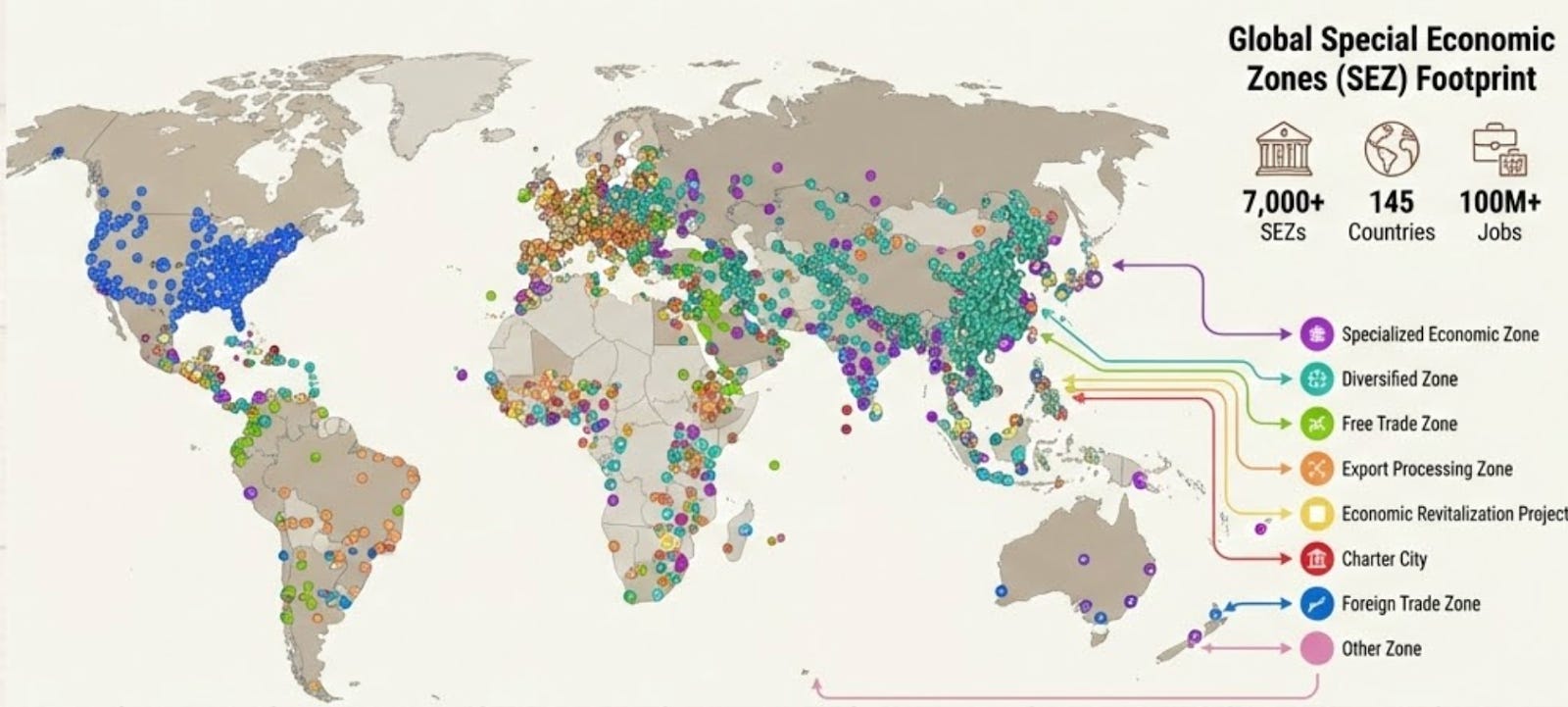
Many of the world’s most dynamic economies emerged through this model. Shenzhen is the emblematic case: it went from a fishing village to a tech megacity by becoming a platform for testing a different regulatory rhythm, a larger scale of investment, and a new relationship between the state, business, and infrastructure.
That is the key point: a SEZ is not valuable only because it reduces market friction; it is valuable because it enables institutional innovation without requiring the redesign of an entire country.
The problem is that almost all of them continue to compete within the same paradigm: attract capital, accelerate growth and scale up, even at the expense of ecosystems, communities or territories. We invite you to try something new.
The emerging regenerative market
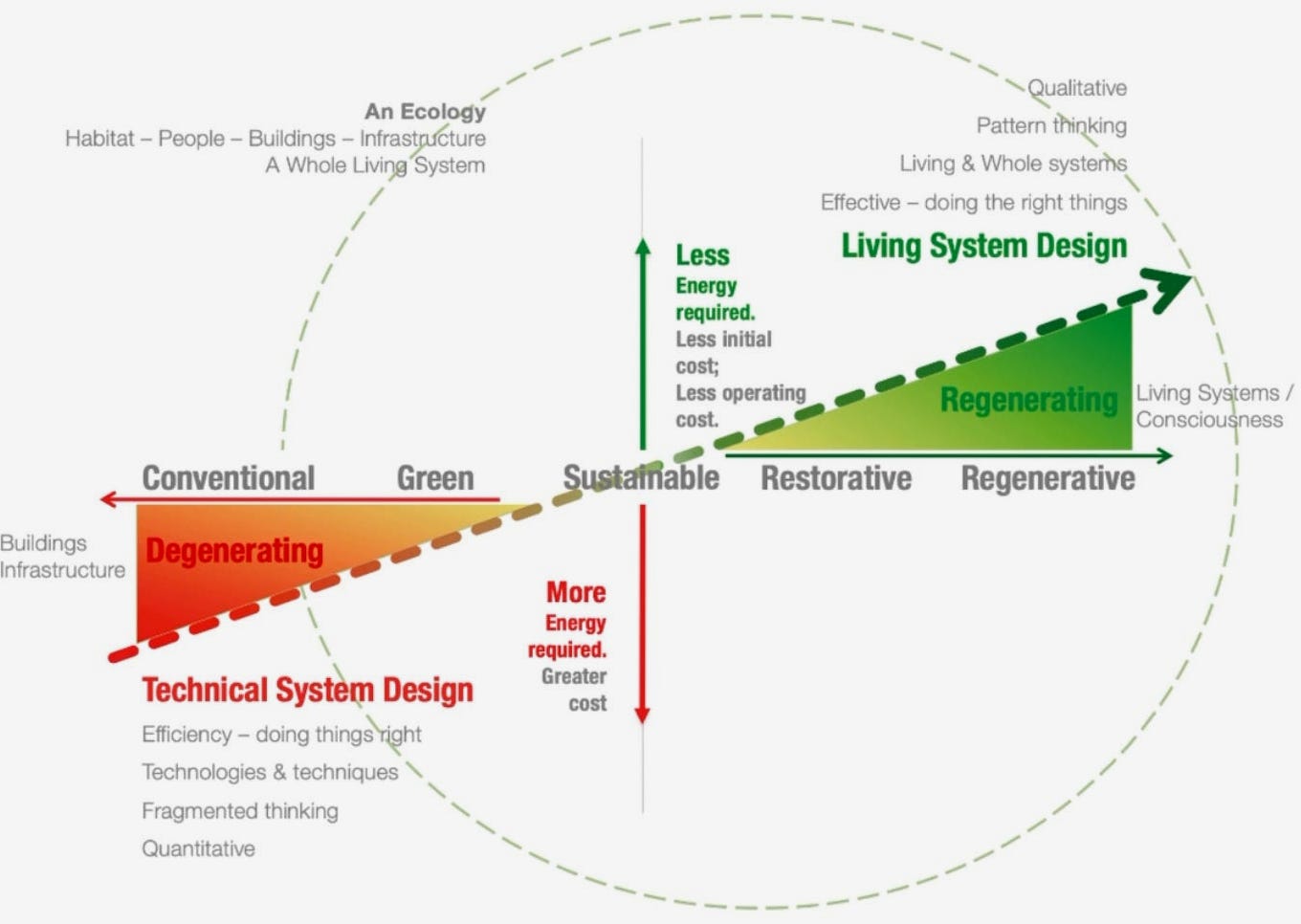
But what exactly does “regeneration” mean? It means understanding that a growing share of 21st-century economic value is already shifting toward complex eco-productive systems and habitats designed to restore, validate, and continuously improve living conditions.
Ecosystem Services
For centuries they were treated as invisible externalities. Today they are beginning to be recognized as a material basis of the real economy. Several studies on ecological valuation estimate that global ecosystem services represent over US$100 trillion annually. We are not talking about romanticizing nature; we are talking about recognizing that the economy depends on living functions that until now we have barely been able to account for.
Carbon Markets
Carbon markets, with all their limitations, show something important: that ecological restoration can begin to connect with financing and verification mechanisms. Its deepest value is not to compensate for wrongdoing, but to open up economic infrastructure to reward regeneration when it can be measured and tracked.
Tokenization of Real World Assets (RWA)
Blockchain allows physical assets and value flows to be represented in more liquid, verifiable, and interoperable formats: regenerated land, biodiversity, distributed energy, agro-ecological production, territorial infrastructure, participation rights, and future income associated with restoration. Tokenization doesn’t create value on its own. But it can create better rails for funding, verifying, and scaling regenerative assets.
Longevity & Wellness Economy
The welfare economy has already reached US$6.8 trillion in 2024 and the Global Wellness Institute projects that it will reach US$9.8 trillion in 2029 What matters is not only its size, but its direction: it is increasingly linked to environmental quality, regenerative nutrition, healthy habitats, biophilic design and prevention. In other words: quality of life is ceasing to be an “extra” and is becoming a central dimension of economic value.
Distributed energy
Microgrids and virtual power plants enable smart, decentralized, and resilient energy networks. They change the relationship between territory and energy, and demonstrate how critical infrastructure can also be reorganized under more local, interoperable, and less fragile logics.
Other examples already visible:
regenerative agriculture
territorial bioeconomy
regenerative real estate
multi-capital accounting systems
ReFi and on-chain impact assets
All these sectors already exist or are emerging strongly. The problem is that they are not yet coordinated. There is still no common institutional infrastructure that links them.
And yet, the opportunity is no longer abstract. Early 2026, the World Economic Forum identified more than 50 investable opportunities across 13 sectors capable of capturing a portion of an estimated US$10.1 trillion in nature-positive business value by 2030. The contrast with the current economy is stark: in 2023, US$7.3 trillion was invested in activities harmful to nature, compared to a mere US$220 billion in nature-based solutions; in the private sector, the ratio was US$4.9 trillion versus only US$23 billion. The problem, then, is not a lack of economic opportunity. The problem is that we still lack an infrastructure capable of making regenerative opportunities legible, verifiable, and bankable.
The hypothesis: connecting Special Economic Zones with regenerative markets
This is where our hypothesis reappears: Is there a place where capital, governance, verification, territory, technology, and legal architecture explicitly align to make regeneration measurable, investable, and scalable?
What if we connect both worlds? On the one hand, the capacity of Special Economic Zones (SEZs) to experiment with rules, incentives, and operational frameworks. On the other, the emergence of sectors, assets, and infrastructure geared toward regeneration. The result would be a new institutional category: Regenerative Impact Special Economic Zones, or simply RISEZ.
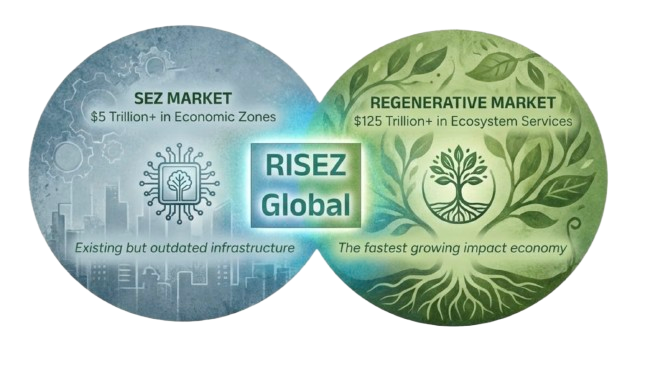
An economic and governance environment where regeneration becomes investable because it is intentionally designed to:
regenerate ecosystems while producing financial value
turn biodiversity into an investable asset class
restore territories while creating new habitats and productive assets
attract regenerative capital at scale
incubate impact ventures
generate verifiable regenerative assets
reduce legal and operational friction
convert regenerative territorial development into economic infrastructure
This framework makes it clearer that we are not just talking about “financing nature,” but about coordinating multiple forms of capital within a single system: natural, social, cultural, intellectual, material, financial, and digital capital. A SEZ does not create value solely through tax incentives or regulatory flexibility. It creates value by designing the environment where these forms of capital combine, are validated, and are transformed into concrete economic flows.
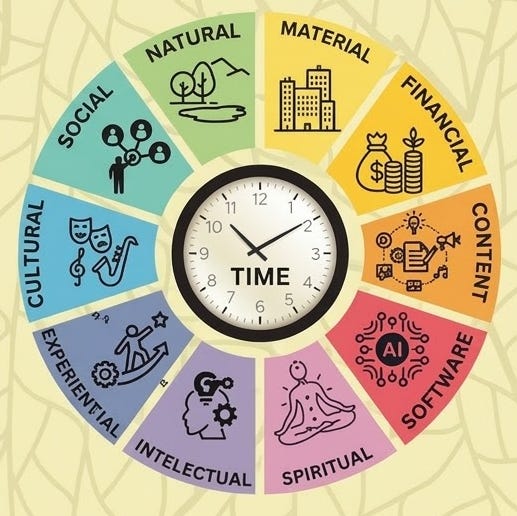
That’s not a technical subtlety: it’s the difference between having isolated projects and having a new economic category. WEF emphasizes that many nature-positive opportunities do not require philanthropy, but rather financing and de-risking mechanisms tailored to different risk-return profiles, as well as coalitions between businesses, private finance, the public sector, and philanthropy to move from scattered projects to investable markets. Seen in this light, a Regenerative District is not just a community, nor just a narrative, nor just a more flexible jurisdiction: it is an institutional layer that reduces friction, organizes data, enables real-world pilot projects, and transforms fragmented initiatives into a coordinated economy.
It’s not just about growth. It is measurable economic regeneration. And markets don’t just appear: they’re designed by people. History proves it. Silicon Valley wasn’t just technology. It was infrastructure, capital, and more.culture and public policy. What we are trying to do now is something analogous, but for the regenerative economy.
So, how are we going to test this hypothesis? Every thesis needs a real institutional experiment. A laboratory where it can be tested.
The experiment: A Pop-Up Island as a founding sprint
Our experiment begins with a Pop-Up Island in Roatán, Honduras, from May 18 to 31, 2026. For 15 days, 55 selected participants from around the world will co-design the first Regenerative Special District within Próspera, with the goal of building together the institutional architecture of the planet’s first RISEZ.
What will we build in those 15 days?
The goal isn’t to leave feeling “inspired.” The goal is to leave with a concrete foundational package:
Founding Charter: principles, rights, obligations, decision rules and legitimacy framework of the district
District governance: roles, advice, coordination, dispute resolution and post-event execution
Impact Accounting Framework: a backbone of MRV and multi-capital accounting, integrating AI, blockchain, and verifiable traceability
Bio-Regional Value Framework: How to convert ecological value into economic assets by connecting ecosystem services, regenerative production, and district economics
Regenerative Impact Fund: Financial structure for deploying capital in regeneration
Roadmap 2040: RISEZ model expansion strategy and its articulation with regenerative territorial developments
The Laboratory: A Prosperous Regenerative Special District
Próspera will be a living laboratory for institutional design. Not a stage for passive panels, but a space for real work, negotiation, creative tension, iteration, and compromise.
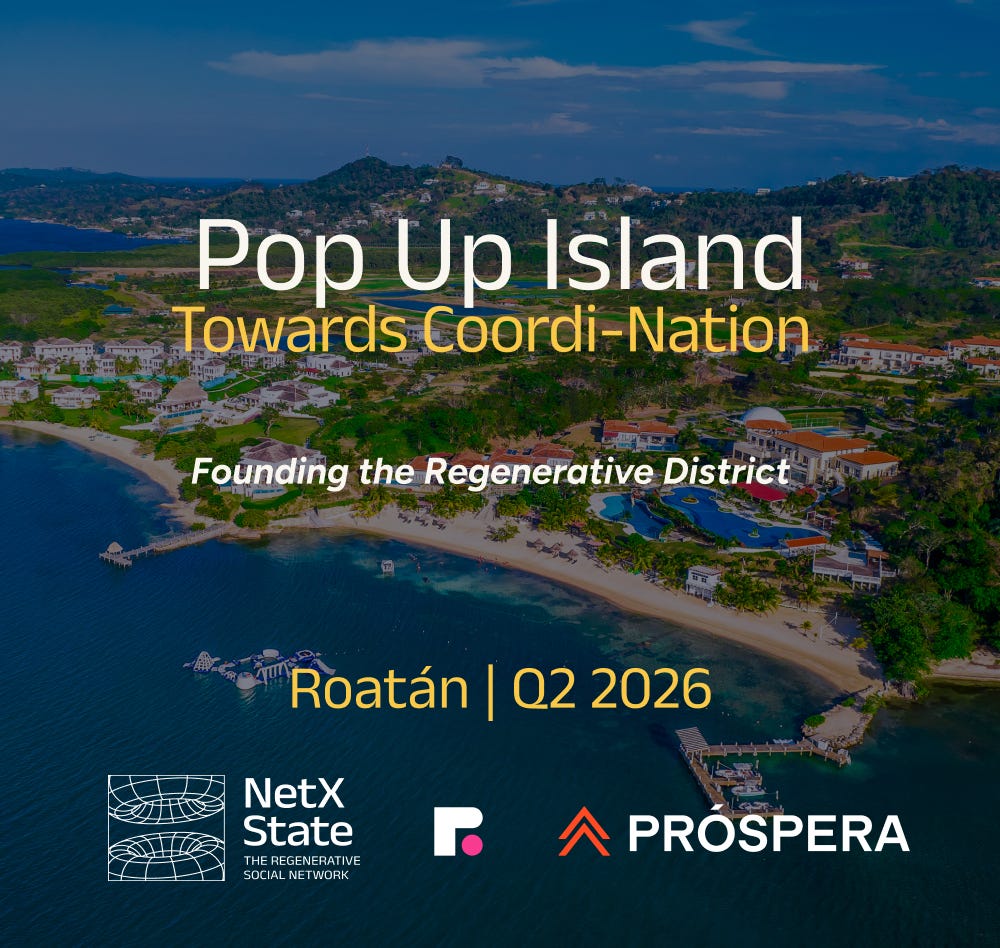
Próspera today it already offers several of the layers that a hypothesis like this needs to move beyond theory: digital registration of entities in less than 24 hours, e-governance, common law, independent dispute resolution, and an environment designed to reduce bureaucracy. On its official website, Próspera lists 413 active businesses in its Roatán area and, in an institutional communication from February 2025, reported more than 3,000 jobs created since its founding.
More than a “zone” in the classical sense, Próspera functions as an institutional platform. And that matters because we don’t want to write another aspirational white paper. We want to build a minimum viable infrastructure for the immediate future.
The first Regen District Service: The Regen Twin Desk model
The Regen District is not just seeking to be a global experiment. It seeks to create a cosmo-local bridge infrastructure that connects territories in Latin America, ecosystems of regenerative projects and startups, and forward-thinking local governments, with global infrastructure capable of opening access to international capital via fiat and crypto rails.
This is implemented through the model Regen Twin Desk A regenerative real estate company, startup, or project can register and operate in its local jurisdiction and, at the same time, digitally register a twin structure in Próspera, accessing global legal, digital, and financial infrastructure.
The goal is not to “move” companies from one place to another. The goal is to build a dual structure that increases competitiveness without expelling value or employment from the territory.
That would allow, among other things:
Create companies in 24 hours instead of months
reduce structuring costs
access to common law and frameworks of trust sought by international capital
operate with fiat and crypto rails
hire globally
access to better dispute resolution mechanisms
internationalize without relocating jobs
This is one of the most concrete pieces of the entire proposal because it addresses a structural bottleneck: the vast majority of regenerative projects in the region today do not have access to a global legal and financial architecture.
Value proposition for key stakeholders in the Regenerative District
Capital
VCs, foundations, philanthropy, multilateral organizations, family offices, and hybrid vehicles
Early access to a new layer of regenerative dealflow: startups, territorial operators, impact infrastructure and regeneration-linked assets —including critical infrastructure, automation, education and governance—, within an innovative environment designed to reduce institutional friction and accelerate investment processes.
The value lies not only in finding projects, but also in participating from the outset in designing a shared architecture for governance, metrics, verification, and coordination. This reduces origination, due diligence, and learning costs, and increases the readability of opportunities that are currently fragmented, dispersed, and therefore difficult to evaluate.
The digital layer for doing that doesn’t start from scratch either. State of ReFi Report 2025 records an ecosystem of over 400 projects, US$298 million raised, US$27 million invested in impact projects, US$26 million awarded in grants, and over 6 million credits issued natively on-chain. But the same report reveals the central bottleneck: a continued lack of upstream capital, non-extractive scaling mechanisms, and structures capable of grouping local initiatives into more legible, investable, and scalable bio-regional portfolios. This is where the Regenerative District can become crucial: as a bridge between global digital coordination, programmable metrics, and real territorial assets.
For patient, catalytic, and strategic capital, the Regenerative District also offers something rare: the possibility of co-designing vehicles, criteria, and tracks that make regeneration more measurable, financeable, and scalable throughout Latin America.
Clue: It’s not just access to projects. It’s early access to the design of the institutional infrastructure that can transform regeneration into an investable, clear, traceable, and scalable market category.
Startups regenerativas
Startups focused on regenerative goods and services
Faster and more accessible structuring and internationalization. Less friction for operating, coordinating, and building a global legal and operational framework from a jurisdiction designed to create and scale businesses quickly and with clear rules.
The Twin Desk model allows a startup to maintain its operations and value creation within its territory, while gaining access to better conditions for hiring, closing deals, receiving and sending payments, expanding internationally, and building trust with global partners and investors.
This is especially relevant for verticals such as climate-tech, fintech, Web3, biotech/longevity, digital services and cross-border payment models, where the current problem is not a lack of talent or market, but the difficulty in accessing an institutional infrastructure compatible with sustainable and competitive growth on a global scale.
Furthermore, startups not only gain access to a corporate structure: they gain access to a network of territorial pilots, real operators, innovative governments, strategic allies, and aligned capital to test regenerative solutions in specific contexts.
Clue: The operation and employment remain within the territory; Próspera functions as a global access layer. The goal of Pop-Up Island is for the first startups and local operators participating in the District’s design to leave with their structure created and operational at the Twin Desk.
Territorial operators
Localized projects in regenerative real estate, hospitality & wellness real estate, productive conservation and agro-production
Access to a global legal, financial, and operational framework without detaching the project from its local context. The District allows for the translation of ecological, social, productive, and real estate value into structures that are more easily understood by international capital, partners, and markets.
Many territorial projects already create real value, but they struggle to translate that value into bankable vehicles, strategic alliances, narratives understandable to investors, or verifiable impact frameworks. The Regen Twin Desk aims to bridge precisely that gap.
This opens up new possibilities for structuring, marketing, traceability, investment attraction, and partnerships with startups, funds, and builders capable of co-developing critical infrastructure, goods, services, and new regenerative business models.
Clue:The territory remains the base of production, stewardship and rootedness; the global layer expands the capacity for structuring, financing and international projection.
Public Entities
Municipalities and local governments, research, development and innovation agencies, universities
The proposal does not seek to remove activity from the territory, but to strengthen it with a double layer: the territory as a productive, social and institutional base; Próspera as a complementary infrastructure to sell, contract, finance and coordinate globally.
A digital export channel for startups and local projects without requiring relocation. A way to attract investment, talent, and pilot projects without the need for large public outlays.
Experimental infrastructure to test legal, crypto-economic and impact innovation with traceability and accountability.
This allows for testing new tools in a measurable, reversible, and evaluable format, avoiding irreversible political commitments before having concrete evidence of results.
Clue: This is not about relocation. It is a digital export infrastructure to boost local ecosystems and an institutional pilot program with accountability adapted to each local government or public entity from day one.
Who is behind this experiment?
Three organizations are driving this initiative: NetX Gen, which originated in Argentina; Tools for the Commons, which originated in Brazil; and Próspera, which originated in Honduras.
NetX Gen
We are a civilizational infrastructure platform focused on building a network of regenerative territories. Its mission is to develop and operate infrastructure, physical, legal and digital so that communities, startups, local governments, funds and organizations can co-create new territories of high quality of life.
For two years he has been working on the ZEEIR concept and found in Próspera a strategic ally to bring that vision to a concrete institutional test.
The core facilitation team includes:
Francisco “Franz” Tuñez: Argentine political scientist, researcher in global governance and blockchain ecosystems, PhD candidate in Global Studies. Co-founder and CEO of NetX Gen. He will be the strategic facilitator of the sprintand custodian of Roadmap 2040 and the general architecture of the district.
Gabriel “Changuito” Calvo: Lawyer, co-founder of NetX Gen, with experience in business consulting, blockchain and Web3 activations in LATAM. He will be the operational facilitator of the sprintand responsible for bringing Twin Desk to a functional version.
Karla Córdoba Brenes: Co-founder of Cambiatus and CofiBlocks, president of the Blockchain Association Costa Rica, a leader in social currencies and regenerative financial systems. She will contribute to economic design, communication, and reward systems.
Gustavo Segovia: Facilitator and designer of organizational systems with experience in governance and crypto-economic design for collaborative organizations and DAOs. He will be the lead facilitator of the sprintand responsible for the human architecture of the process.
Nadia Karabin: As the Regen Real State coordinator of NetX Gen she leads the articulation of the local ecosystem, connecting territorial development and regenerative economics. Strategist in real estate investment, crypto-economics, and tokenized asset structures, with experience at the intersection of blockchain infrastructure and real-world assets.
Próspera
Próspera provides the experimental jurisdictional environmentA space where it is possible to combine law, digital-first operation, market, coordination and governance in a way that is hard to find elsewhere.
Tools for the Commons
Tools for the Commons develops digital, financial, and operational infrastructure for new innovation ecosystems and economic zones geared toward the knowledge economy. Its role is key because it translates complex legal and administrative frameworks into usable interfaces: digital business registration, administrative coordination, interoperability, and financial tools. In other words, it makes the institutional infrastructure operational.
How will Pop-Up Island work?
Roatán is not a marketing detail. It’s part of the logic of the process. Founding moments rarely happen in corporate hotels under white lights and identical coffee breaks. They happen in places where people can think, connect, imagine, and build with intensity.
Sprint Sequences
Days 1–2 — Arrival & Sensing: Landing, alignment, common language and capability mapping.
Days 3–4 — Honest Diagnosis: Participatory diagnosis, expert provocations and mapping of opportunities, constraints and coordination failures.
Days 5–9 — Generative Design: Small teams with clear mandates co-design governance, metrics, capital architecture, bio-regional frameworks, and pilot projects.
Days 10–11 — Testing & Refinement: Institutional red team. Stress test of assumptions, governance and incentives.
Días 12–14 — Commitment & Founding: MOUs, definitions, commitments, signing of the founding package and founding ceremony.
It’s not just co-creation. It’s co-creation geared towards binding outputs.
Who are we looking to join?
This isn’t for spectators. It’s for people and organizations with a genuine desire to build infrastructure for the regenerative economy.
Investors, funds y family offices
For those who want to participate early in the design of rules, vehicles, and criteria by which regeneration can become a serious investment category.
Startup founders
For those who want to build solutions with global ambition, but connected from day one to real territories, pilots and needs.
Web3, AI and ReFi Builders
For those who want to turn emerging tools into workable infrastructure for governance, coordination, MRV, and impact accounting.
Local governments, SEZ architects, policy designers, and experimental governance
For those who want to explore new ways of articulating territory, competitiveness, institutional innovation and investment without having to redesign an entire country.
Regenerative practitioners and territorial operators
For those who want to contribute situated knowledge, real cases and territorial criteria to an architecture that cannot be designed from abstraction.
Ancestral, community, and indigenous leadership
For those who want to ensure that these new architectures serve life, territory and communities, and not just capital.
We’re not just looking for self-interest. We’re looking for sound judgment, a diversity of skills, and a genuine willingness to build something new together.
Why now?
Many talk about the future. Few try to design it institutionally.
The institutions of the century
The 20th century was not designed for the 21st century—and even less so to simultaneously integrate capital, territory, technology, governance, legal frameworks, and verifiable metrics.
Our thesis is simple:
Simply put, if we want a regenerative market, it’s not enough to just talk about it, partially fund it, or wish for it. We have to build the infrastructure that makes it possible.
We’re not starting from scratch. A nascent market already exists, as do MRV tools, smart contracts, on-chain assets, and new multi-capital coordination vehicles. What’s still lacking is an environment where governance, metrics, legal structures, and de-risking mechanisms are aligned from day one.
That is precisely the historic opportunity of a Regenerative District: to intelligently accelerate the transition from an extractive economy to a regenerative one without waiting for the entire system to change on its own.
This implies:
new jurisdictions
new incentives
new capital rails
new measurement tools
new forms of governance
new bridges between the local and the global
Regeneration won’t scale up solely through moral conviction. It will scale up when there is an institutional architecture capable of making it competitive.
That’s the experiment.
That’s what we’re going to try in May.
55 people.
15 days.
A district.
An open hypothesis.
And the possibility—still rare, still fragile, but increasingly real—that regeneration will cease to be a peripheral aspiration and begin to become concrete economic infrastructure.
So we have two options:
Wait for someone to redesign these rules.
Or we can do it ourselves.
How to participate:
Founding Steward
10 seats · USD 10k–20k
Full participation + accommodation + role in the post-event Operating Council.
Book a call with us
Founding Builder
USD 3k
Full participation + hosting + contribution to sprint workstreams.
Apply here
Founding Ally
Partial or full scholarship for strategically essential voices: community leaders, regenerative practitioners, territorial custodians, and indigenous leaders.
The logic is not to rank people by ability to pay.
The logic is to recognize different forms of foundational contribution: capital, labor, knowledge, territorial legitimacy and operational commitment.
🔗 Key Links:
→ Luma Event
→ Apply Here
→ Apply Scholarships
→ Book a call with us